Job’s Not Finished: Article 1
Form Follows Fiction
Written by Matthew Taylor
Speaking exclusively with some of today’s leading creative thinkers, CONCEPT(K) examines how storytelling has become the essential foundation of modern design.
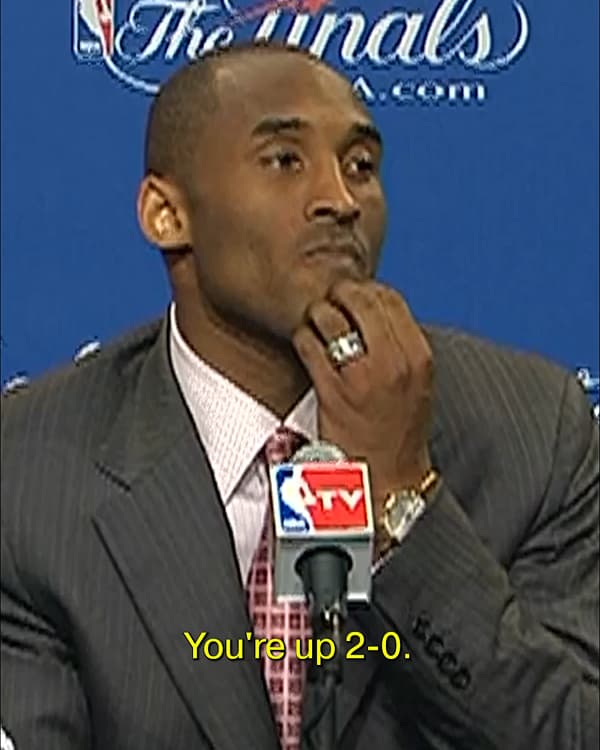
When asked by a journalist why he looked unhappy despite the Lakers being 2–0 ahead in a best-of-seven series against the Orlando Magic, Kobe Bryant gave the iconic reply: “Job’s not finished.”
The Lakers went on to win the series 4–1, perhaps largely because of Kobe’s refusal to acknowledge what others may have considered “excellent” as enough. Using this as an analogy for the design process in today's landscape, a well-designed, functional product — no matter how well executed — represents a similar situation:
An outstanding achievement? Definitely. Better than most of the competition? Quite possibly. But in terms of achieving the larger goal of commercial resonance and cultural relevance — is the job finished?
Put simply, great aesthetics and functional design combined with traditional methods of product rollout are no longer enough. While classic formulas such as exploded views and athletes on billboards may have once stood out, audiences — and their expectations — have changed.
A product now needs to be imbued with narrative. It needs a point of view that moves an audience and appeals to their values; something that makes them care.
A product also needs to exist in a world built around it — and where previously that world may have been handed to other units within a business to construct as a post-rational (marketing, PR, etc.), today, for standout products and brands, the story begins at inception.
But why is storytelling important? Felipe Guimarães, ECD of legacy advertising agency BBH, puts it bluntly:
“People don’t buy products. They buy brands. And brands are built on the stories they tell. Create a world I want to be part of and use your products as a gateway into that world. Good design epitomizes the world you are trying to create. Tell me a story so good I want to be — have to be — a part of it.”
But when did this become necessary? And why — and how — have audience expectations changed? According to Cameron Temple, ECD of digital agency STINK, great aesthetics now only qualify you for a seat at the table:
“Without a story or deeper concept behind what we create, it’s very difficult to establish any sense of connection or resonance with people. As a result, what may have stood out 10 or even 5 years ago can just fall flat without a story to elevate it within the sea of sameness.”
Temple goes on to describe an interesting inversion on traditional standards; minimal production value paired with strong narrative can out-resonate a high-budget campaign that lacks one:
“On the other end of the spectrum, we constantly see stories succeed without any visual craft or refinement. How many TikToks have you seen with 1M+, where the content is just some roughly greenscreened video onto a stock background? That’s because the relatability chord it strikes far exceeds the visual value.”
He concludes by asserting that a compelling narrative, combined with modern visual tools, has become the new creative bar:
“When we combine the two is when things really take off. An authentic, relatable story that connects with the audience, powered by the incredible tools we have at our disposal in 2025, is what differentiates ordinary from extraordinary.”
If the standard for creative resonance has shifted from “form follows function” to “form follows fiction”, what does that mean for designers?
To gain relevance, it has become vital to consider a product’s story from inception through to release. Every designer represents their own personal brand and journey — and thus is constantly telling a story, whether to themselves, their online community, their team, or directly to a customer.
Errolson Hugh of ACRONYM frames it perfectly:
“Whether you like it or not, as a designer, your work/product/brand/career is part of a narrative, is telling a narrative, is being evaluated based on its narrative.
Everything tells a story, at every level, all of the time.”
He continues:
“When all of the narratives of a given thing are congruent — from form to function, process to product, micro to macro — that’s when the magic happens. That’s when you get resonance, connection, and meaning.”
Today’s best brands and designers embody this layered congruence. They don’t just release objects; they reveal processes, sketches, and prototypes. They show the conversations, the collaborators, the intent. This transparency itself becomes a form of storytelling — one that audiences trust.
Hugh adds:
“Narrative is also why brands that people actually care about are not primarily driven by the money. ‘We made this to make a lot of money’ is a boring-ass story.”
It’s a truth that anyone in professional design — especially fashion — knows instinctively. When smoke and mirrors clear to reveal profit as the primary motive, even the most technically accomplished work can feel hollow.
Hugh concludes:
“Learning to read and write a product narrative is like learning to read and write a language. You need to know the vocabulary, understand the grammar, and be aware of cultural and historical context. It takes time (the learning never ends), and you will make mistakes. The mistakes are the only way forward. Telling your own narrative means that no one else has told it before, so you have to figure it out as you go along.
Who tells the best story, wins.”
Just as every human being is unique, any creative work containing this much personal perspective must therefore also be as unique. Creating from a point of view that is true to one's individual self is telling your own story, and the benefits of working with this in mind can span any discipline or genre.
Tobe Nwigwe, artist, actor, and rapper, explains:
“Everything that I do and present is from my real life. It's not something I've curated or made up. I'm marketing my brand, my actual life, and my genuine experiences with the people I actually do life with.
It's authentic in the sense that I'm not a character, I'm not a caricature of myself, I'm literally myself in real life — on stage, in front of any camera, or on any award show.”
Nwigwe’s point raises a question familiar to many creatives: should the creator be separate from the creation? Plenty of artists see their creations and themselves as separate, certain parts of their life are not part of their creative process and vice versa. Nwigwe, however, takes a different stance:
“There's a specific way that people tour — I don't tour like it. There's a specific way that people do a whole lot of things. Being authentic and genuine (although I had no idea if the industry would really allow me to do things the way that I saw fit), I wanted to maneuver with my family and be with my wife and children. I did that, even though it was taboo.
I wanted to do things practically and exactly how I wanted to do them. It's been an immaculate experience, and I've had so many people — big-name artists and smaller artists — tell me they wish they approached things the way I did.”
Nwigwe embodies his story, he doesn’t have to create a story around his work any more than he has to breathe or blink. In today’s online environment, where one of the hardest things to do is to be yourself while everyone is watching, his approach is rare and powerful.
Of course, putting forward your life as the center of their own narrative is not the only powerful method of storytelling. Designers and creatives working within large organizations combine their stories with those of colleagues and collaborators.
Thibo Denis, shoe designer at Louis Vuitton, highlights an important consideration for footwear designers in such environments: a product as part of an outfit, a collection, and a larger brand universe.
“I think we all enjoy the initial idea — the moment where you imagine the pair but also the silhouette and the person who will wear it. There is like a script… and with the development you work with collaborators… and they help you to bring it to a point that maybe was not the initial idea… And the ‘accident’ through the process often brings it to another level…”
Denis’s perspective reminds us that the design process itself is a story — one that evolves as it’s made. Beyond that, a shoe contributes to the story of an outfit, which contributes to a collection, which contributes to the evolution of an ongoing brand narrative.
Greater commercial resonance can come when these layers reveal themselves as the audience interacts with the brand: perhaps they see the runway show and connect with the concept; later they spot someone they respect wearing a particular piece; then they discover some behind-the-scenes sketches and development on the designer’s Instagram; finally, a retail activation completes the arc.
With the benefits of personal narrative established and its role in a wider structure, what constitutes a good story for an individual project?
According to Lukas Bentel, Creative Director at MSCHF:
“Concept is king, and narrative is never an afterthought; it’s a structural element we consider from the inception of an idea. At MSCHF we have a saying, ‘It has to slap in one sentence, but slap harder in three.’ That means the work's story should resonate on impact, but also reveal deeper layers of meaning when contemplated further.”
This echoes the late Virgil Abloh’s idea of designing for both “the tourist and the purist” — engaging audiences who make quick judgments as well as those who dive deep into detail.
Bentel continues:
“When working through an idea, we are always asking what is the best vehicle for the concept. It’s not always the same; sometimes it’s a website, sometimes a painting, sometimes a product. We see products as an underutilized delivery system for ideas. Unlike traditional fine arts, everyone knows how to relate to consumer products. We are surrounded by them. We know how to use them, play with them, wear them — and through our interactions with these objects we can co-author new narratives. Sometimes the story is in the object itself; other times it provokes one.”
Bentel’s take highlights the fact today’s product stories are no longer linear. A story could be a point of view, a personal journey, a fascination with an object or process, or an abstract concept that frames the product in a new light.
Given that we are all telling our stories through design, a considered narrative allows designers to speak from a deeply personal place about what they’re creating and why.
Alberto Deon, founder of Daemon Footwear, frames his design narrative in the following way:
“I tend to personify my products. Every design I create is part of a family — they share DNA, values, and a sense of lineage. I think in genealogical terms: each shoe is a descendant of the first, a new branch on the same tree.
My creative flash began with Poyana — that was the origin, the pure spark. Everything since has been an attempt to preserve that original alchemy while evolving it, scaling it, and translating it into new forms. I never start from zero; I start from inheritance. Each product carries the story forward.
With storytelling’s rise comes another challenge: authenticity has become a differentiator.
Alex Hill, CD at creative studio Builders Club, cautions:
“There’s a fine line between artistic storytelling and marketing fluff…
We’re all used to products having stories — sneakers, watches, beauty products, you name it. We’re bombarded with ads 24/7, all trying to hook us emotionally or upsell an aspirational lifestyle. The problem is, a lot of it feels surface-level.”
The power of narrative hasn’t escaped marketers — but saturation brings its own risks. This is another truth that many designers and creatives will recognise, if you hear talk that something needs to “feel authentic”, it probably won't be.
Hill continues:
“It’s like the difference between a manufactured pop band and an artist who actually has something to say. The former might have mass appeal, but they’re recycling the same generic lyrics and sounds. The latter might not be for everyone, but they’re pushing boundaries, experimenting, and creating something more lasting.”
Hill is essentially asserting that when everything claims to have a story, the only stories that truly resonate are not ones told primarily for commercial gain. With a manufactured story a product may reach a large audience in a short amount of time, but it rarely lasts and becomes ingrained in culture.
Hill continues:
“It’s like the difference between a manufactured pop band and an artist who actually has something to say. The former might have mass appeal, but they’re recycling the same generic lyrics and sounds. The latter might not be for everyone, but they’re pushing boundaries, experimenting, and creating something more lasting.”
Hill is essentially asserting that when everything claims to have a story, the only stories that truly resonate are not ones told primarily for commercial gain. With a manufactured story a product may reach a large audience in a short amount of time, but it rarely lasts and becomes ingrained in culture.
Before concluding, allow me the indulgence of a personal reflection amongst such esteemed company.
When designing, I am always exploring a tension between two seemingly unrelated or even opposing ideas and searching for a midpoint between them. I am searching for a way to make sense of a contradiction. That tension is my narrative. In many ways, I probably am a contradiction myself.
Through iteration, I’ve built an evolving guide — a set of questions I ask to test whether a product narrative functions beyond the product alone, questions such as:
Do the ideas extend to language?
Can they be explained concisely?
Do they connect to symbols, graphics, or motion?
Do they relate to any cultural conversation? If so, where do they sit within it?
This process acts as a trigger for internal dialogue and also as a set of measures and balances to keep me from wandering too far from a certain path. Do I occasionally wander? Of course. Does this process make the end result better? Who knows, but in going through this process I am continually trying to refine what it is about my individual point of view that I’m trying to explain with a product.
The process of design has always been iterative — but in 2025, iteration means more than form following function. It means form following fiction. Every thought, sketch, render, annotation, outfit, or conversation can become a sentence in a larger narrative.
Like Kobe’s quiet defiance in that press room, it’s about refusing to settle for what has historically been good enough. The design is done but the job’s not finished — not when the product ships, not when the campaign lands. It’s finished when the product and its narrative come together to form something greater than the sum of their parts.